I know that normal authors include something like a "Bio" on their websites, but I have something better for you.
My name is Mara San Farino. Actually, Mara di San Farino - although that sounds a little over the top, doesn't it? In Slavic territories people also know me as Mara Svetobrashen.
Some of you polyglots may wonder why my surname resembles something like... Saint Male Flour. Well... there is a whole legend behind that.
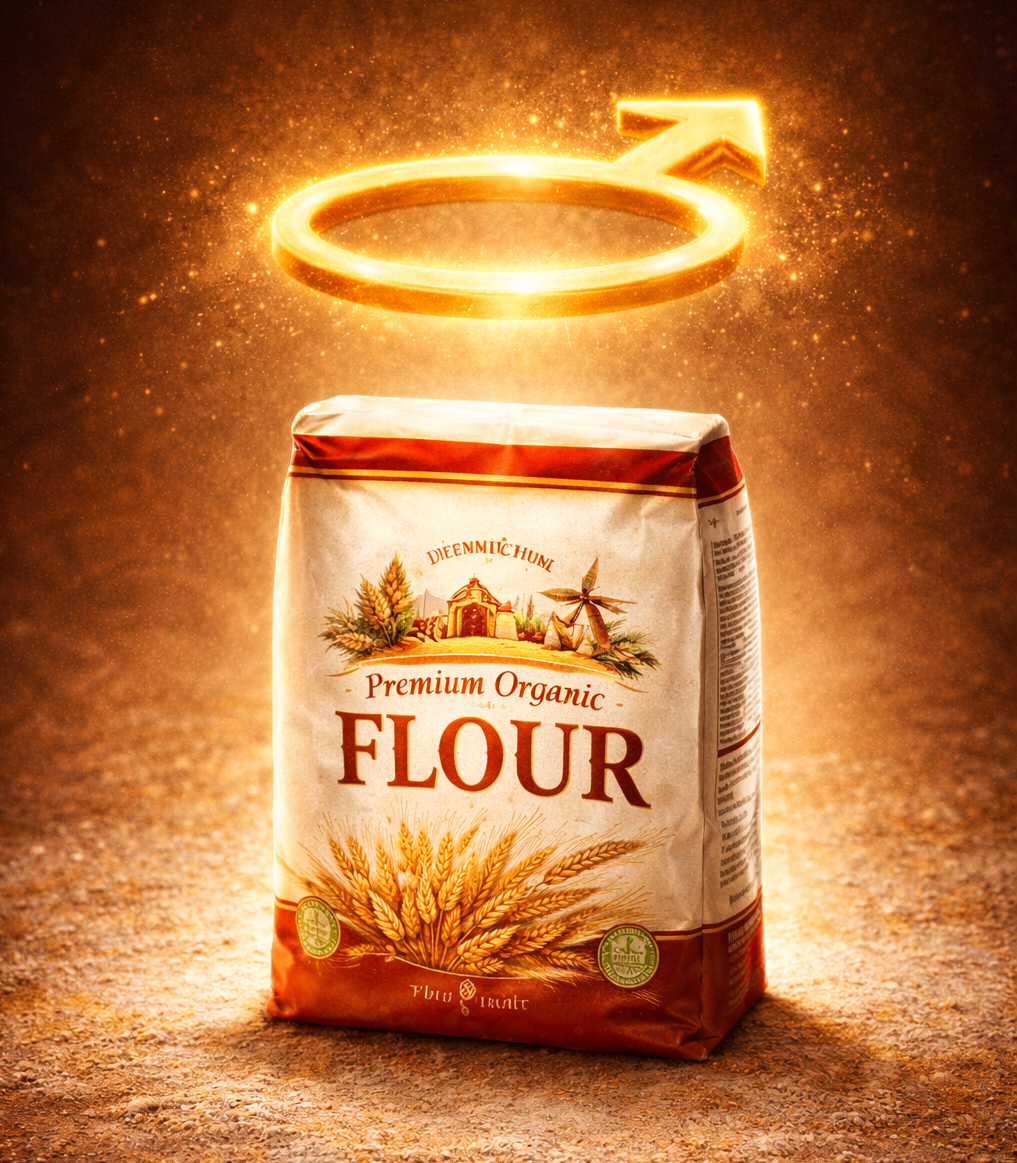
San Farino is a small village in Italy, Mars. (Yes, there's Italy on Mars too). I am half Martian-Italian and half Human-Italian... who doesn't speak Italian at all. The village has carried the name of a saint called San Farino ("Svetobrashen") for more than 300 years. Apparently, I am a descendant of this saint, who is alleged to have had Italian and Slavic roots. This is why my Martian Grandma likes to joke about me having extraordinary capabilities.
When I tell you the legend of San Farino, you will see that not everything is as strange as it seems. Sometimes it's even stranger.
In the 1550s, in the Italian region of Tharsis, there was a village with a name too long and illegible. Let's call it L for now. It was the home of a mistress of dough, selling pastries with a taste so magnificent that her fame had spread throughout the whole Martian world. People called her "La Farina". She was likely Human-Italian; some sources suggest a Slavic origin.
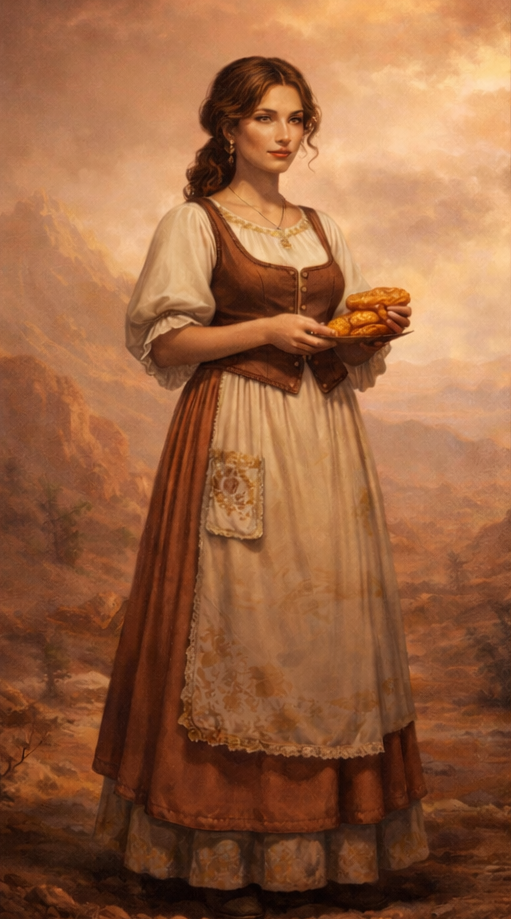
A visual reconstruction of La Farina, derived from fragmented historical records. Certain unusual features remain open to interpretation, though some accounts suggest they may reflect physical traits possibly influenced by the Martian climate.
La Farina's bakery had only existed for a few years, but everyone who tasted her pastries seemed to experience a delight previously unknown. Historians have speculated that faraway areas such as Syrtis and Isidis developed faster means of transportation solely to enable delivery of the almost magical dough goods.
Lately, there had been rumours about a new recipe, and that only a selected few had had the privilege of trying these new "finest pastries".
L had a rather unusual landscape - just a few visible buildings, which appeared abandoned, and a major part of its infrastructure located inside a lava tube. The inhabitants had shaped the visible, above-ground part to resemble Tuscany, as they wanted to honour their Human population (about 40% of the total). Later, artificial vegetation was added; however, even prior to this, it was difficult to discern that the village lay within a volcanic region.
Due to this underground structure, finding L's exact location was virtually impossible for outsiders. For this reason, the village was spared the attacks of foreign armies that had regularly affected most other cities and settlements. Yet there remained one factor no one had considered, one that would later prove crucial in the village's history.
Do you know any star chefs of today? Andromedo Giacomo di Cadipadell was the equivalent of this in the post-medieval Martian period. Born in the early 1500s in Elysium, half Martian-Italian and half Martian-Greek, he felt proud to carry the heritage of two cultures famous for their culinary skills. Andromedo had dedicated his life to being a master of dough and to receiving praise for his best creations. He was particularly known for inventing a special method which included frying the dough. Although frying was later adopted by many, the results were never comparable.
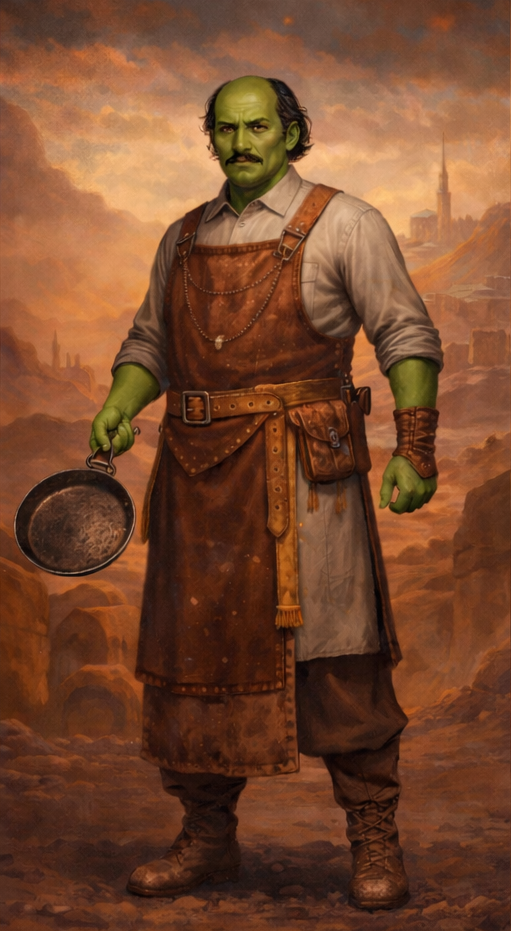
Cadipadell was not particularly fond of Humans, as he believed they had come to take over the Martians' crafts, and the only time he could tolerate them was if they were his customers.
Andromedo had harboured a strong dislike of La Farina since 1549, when the Elysian King's capricious daughter, who always criticised even the finest cuisine, called his most exquisite bread "plain". From her mouth, this could be considered a praise. The only time the princess actually tasted something to her satisfaction was when she tried La Farina's pastries. "It has taken you long enough to discover food fit to my taste!", she exclaimed.
Cadipadell and La Farina had never met personally and he was not aware of the location of L. It is unlikely that anyone else in the country was, as couriers transporting goods from the village most likely entered through other underground paths with faraway entry points. La Farina had once been challenged publicly, with Andromedo suggesting that she should show her face, but she never responded.
In his fifties, however, Cadipadell's resentment of La Farina had turned into an unhealthy obsession, as he believed that she had started frying dough goods, using his method. It is unclear where this assumption came from, but either his own fixation escalated or Cadipadell's brother, in the hope of him retiring sooner, made such a suggestion.
"The greatest Martian master of dough" was not going to allow somebody green and Human to copy him. (Cadipadell had a habit of calling every master or mistress of dough with less than ten years of practice "green" - he could get away with it, considering his own skin complexion. Had the G-word been used by a Human, it would most definitely have come across as spacist.)
Andromedo needed to know where the village of La Farina was located and nothing would stop him from finding out. For months, his apprentices tried to trace couriers from L, only to fail every time, as they seemed to "vanish into the rocks".
Cadipadell knew somebody had to be traced - the alternative of walking almost 2.000 km around the base of a volcano in search of an underground village was unthinkable. He decided to go himself.
Andromedo went to the place where he last saw his current target and found nothing but solid basalt. He knocked, pushed, walked around it - no entrance, no mark. Nothing to even indicate Human or non-Human access. He sat down, breathing heavily. There had to be a solution. He had not gone all the way to Tharsis in vain.
As he got up to leave, he stumbled and fell onto the rock - and, to his greatest surprise, it split and revealed a tunnel. That was it - one of their lava tubes. After the entrance closed, he fell onto it again, supporting himself with his elbow. No result. It soon became apparent that one had to push the rock with their whole body mass at an angle of about 45 degrees. That was everything he needed to know.
Now there was only one thing left to do. Cadipadell had a friend whose sister was married to a high-ranking warrior in Arabia Terra. Informing that friend that there was a village in Tharsis with rich supplies of red gold - and explaining what it took to open its entry point - was going to do the work.
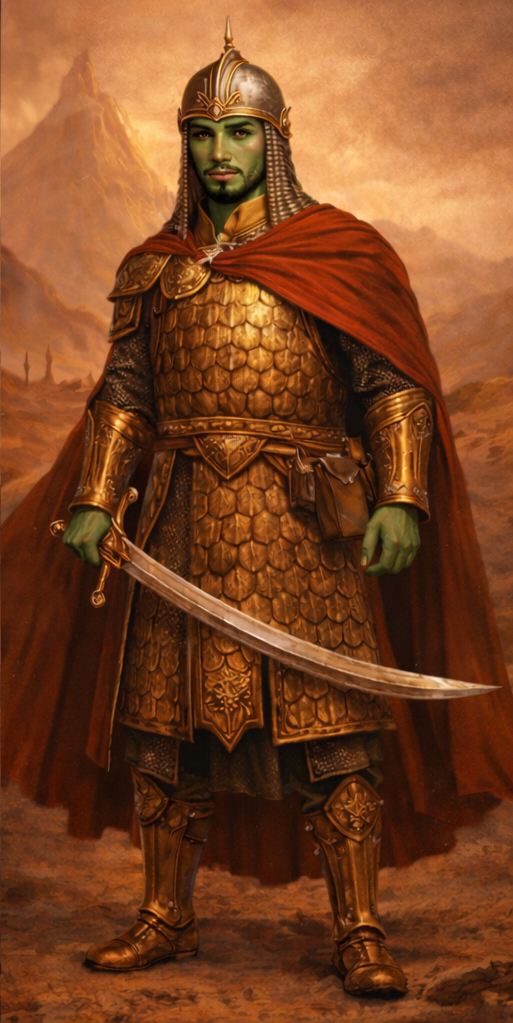
Vakhab IV was the most powerful and skilled warlord of his time, and he was feared far beyond the borders of his lordship, Arabia Terra.
His army had been trained with advanced methods, unavailable to the rest of the Martian world and was considered undefeatable.
Cities and villages that had experienced Vakhab's temper knew that even surrendering and giving away their valuables was not enough to prevent destruction. His promises were the last thing to rely on. What helped was only not being on his way.
While Vakhab IV was famous for his cruelty in general, there were three things he hated the most:
- somebody pronouncing his name as [Vak'hab] instead of, correctly, [Va'hab] (You may wonder what that "K" even stands for, but Martian Arabic obeys no other rules but its own.);
- Humans and
- even a slight implication about his feminine side.
It certainly didn't help that he was strikingly handsome, but something in his facial features gave him a hint of feminine softness. Rumour has it that he had his own cousin's tongue cut off after the latter joked that the lord would look very beautiful in a woman's attire.
***
Vakhab made up his mind the moment he heard about a hidden village full of red gold. However, the gold was secondary. His eyes would light up at every opportunity to fight... to conquer... and to kill. Tharsis was one of the few areas he avoided raiding due to its geographic particularities, but this time he was going to make an exception. After all, nothing and nobody was more powerful than him - not even the largest volcano in what was soon to be known as the Solar System.
The warlord, his adolescent son and a few of their men dressed up as merchants and entered L. The village people were suspicious, as they rarely had visitors, especially not groups.
The men saw La Farina in her bakery. With unusual firmness in her glance, she said,
"Gentlemen, will you not do us the courtesy of tasting our finest pastries?"
Vakhab stood there confused by the strange look in her eyes and could not silence his curiosity. He had heard of La Farina and her pastries. Were they really so good? What was this Human planning? So young, how could she outperform every Martian master of dough? Did she even suspect what fate was expecting her village?
He had one of his warriors try the pastries first. Five hours later, everything was normal and the man would not stop praising them.
"We may as well try", the warlord thought. "They don't know. They have no way of knowing."
It was getting late. The attack would take place on the next day. The village was not going to discover their identity until then. The rest of Vakhab's army was already close and would be there right on time. So Vakhab, his son and everybody else tried the pastries and were inspired by their heavenly taste.
The next morning did not go exactly according to plan.
"Father! Father!"
"My lord, a maiden cries out for her father... My lord...?!? Holy slopes of Utopia!"
"Son...?!?"
Vakhab put a hand to his chest in shock and found some... geographic particularities that should not have been there.
High-pitched voices rang out everywhere. The men looked around and saw the reality - loss of body hair, unfamiliar softness in their features and other changes they had not asked for.
Everybody was gasping in terror. Only the two captains, Audacius Maximus and Rashid 'Ayn an-Nasr, were calmer than usual and quietly entertained by the situation - including the fact that the lord was, indeed, very beautiful.
***
Vakhab stormed into La Farina's bakery.
"What hast thou done, thou venomous witch?!?"
"How may I serve you, my fair lady... O, I see. My fair lord, are thou not feeling well?"
"How shall I yet show my face before the world, what shall happen to my land... to my son?!?"
"This, my lord, is the lot of any who enter this village not as a guest. I must add this: the change is not beyond remedy - yet."
"Not yet?!?"
"The sun shall rise once more."
"There is nothing I will not swear!"
"Thou and thy men shall depart this village unmarked, and never set foot here again. And this time, thou shalt keep thy oath."
"So be it. I beg thee!"
The warlord consumed the antidote and returned to his previous form. So did his son and the other men, except for Maximus and Rashid. Rumour has it that they ran away into the woods and were never seen again, but I doubt that. The artificial vegetation didn't exist yet, so it's more likely they disappeared into some unknown lava tube.
Vakhab, thankful for not having to spend his life as a warlady with a daughter, left the village for good.
Chronicles show that La Farina knew well what risk she was taking. Had the warlord broken his oath, a different bread would likely have been served.
This was the first known time in history when Vakhab actually kept his word. Even elsewhere, no attacks from him were documented after that moment.
***
Andromedo di Cadipadell waited impatiently to learn whether La Farina's village had been attacked. He never heard the full story, only that no attack had taken place - and that La Farina had somehow been the reason. For the first time he felt curiosity in the place of anger. La Farina was full of surprises. So he, the greatest Martian master of dough, actually underestimated that Human after all. If she really outsmarted Vakhab IV, then perhaps she deserved to take over his craft.
About 10 years later Cadipadell retired peacefully.
La Farina lived a long life and passed away in the early 1600s.
For her merit in protecting the village, she was canonized as a saint, from then on called San Farina / Svetobrashna.
Decades passed and her diary was discovered. It contained a passage which appeared, mildly said, rather controversial:
"Ye who call me La Farina, cease. I am Il Farino, and so I am made. Through the finest means the finest outcomes are achieved."
Rumour went around and speculations started. Some historians actually believe that this was exactly what La Farina was aiming to achieve. The Bishop was getting impatient. It was unheard to have in the Canonical Register a saint of the wrong gender. Clerks were sent to search for information from the Roll of the Dead, however, in La Farina's record, no data about gender was found.
It is documented that the church held an emergency gathering, the contents of the discussion are not known to historians. Some claim proof was found that La Farina was, indeed, biologically male. Others believe that the Bishop waived further inquiry. Possibly the church came to the conclusion that La Farina's extraordinary capabilities by far exceeded those of a woman, so logic required that she must have been male. Or perhaps there was too much local pressure. The fact remains, however, that the Saint was recanonized as San Farino.
The village was renamed to San Farino in 1688 and has since then mostly prospered. Its tradition of keeping its location secret has been preserved by today, finding a modern expression in the fact that it is still the only village without an assigned postcode. They haven't really missed much - today it's mostly about invoices, tax documents and legal notices anyway.